 David Brill
 Origami Camp Puyuan 2025: D’nA in PRC
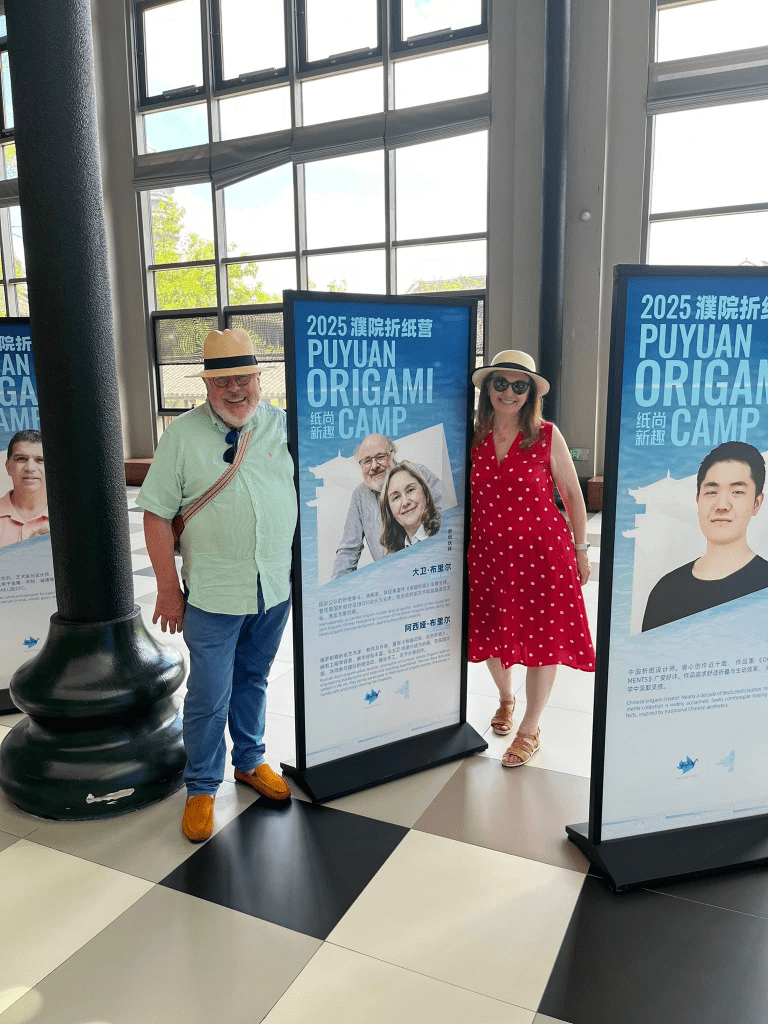
During 2021, Pan Hang, a Chinese events organiser and origami enthusiast, asked me teach at a Chinese on-line convention held that summer, and of course I accepted. During that virtual event I enjoyed teaching and talking with Chinese folders. Later, Pan Hang hinted at the chance for me to visit China in the future…
Pan Hang has now organised several large in-person events with Vincent Floderer, Robert Lang, and Nicolas Terry among the invited guests. China has many fine emerging origami designers, who have recently been popularised by several fine books published by Nicolas Terry in recent years. Their work is well worth exploring. Assia and I were excited to meet many of them in person this summer, at an origami event quite unlike anything we had previously experienced.

The latest and grandest of Pan Hang’s projects was the 2025 Puyuan Origami Camp. It was attended by about 400 delegates, for four consecutive events each running from four to six days during July and August.
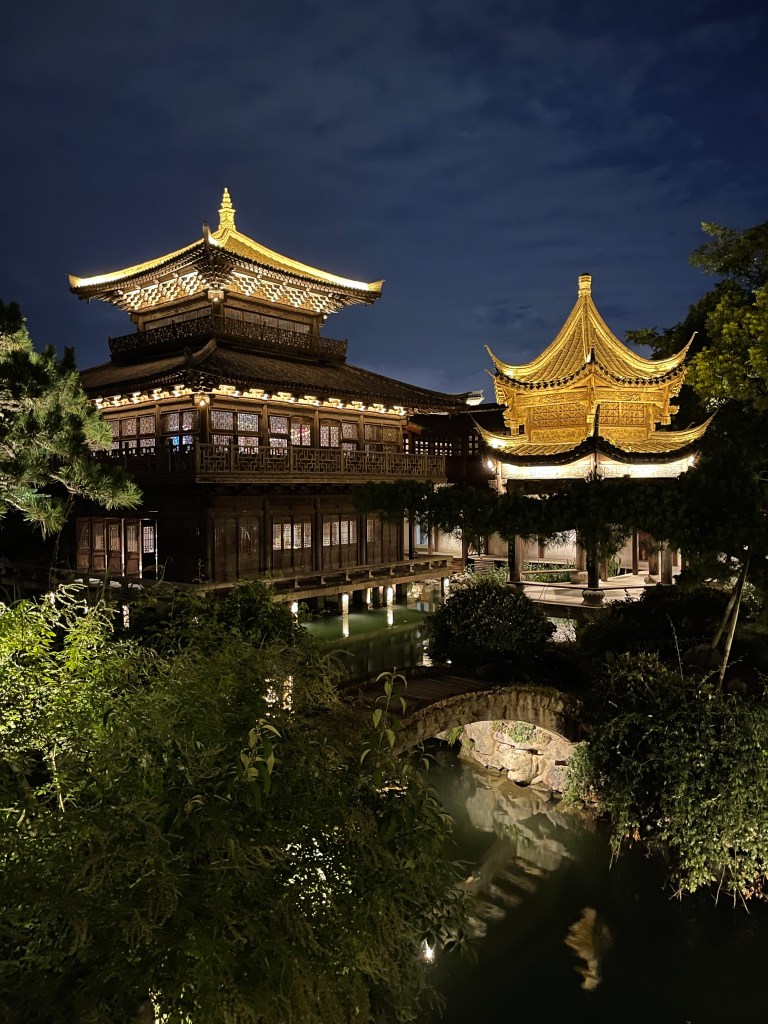
Puyuan is an ancient and elegant water town, now a resort for day visitors and for longer stays. It is reminiscent of Venice. It proved an unusual and ideal venue for origami enthusiasts, many of whom who stayed onsite at the 5 star Meishang Hotel, along with no less than 28 invited guests from China and abroad.

We were very proud to be chosen among the invited guests. Arriving on 19 July, we were collected at Shanghai airport and then taken by car to Puyuan: about a two hour drive. We were amazed by almost everything we saw on arrival: the palatial entrance and booking hall, the elegant waterways and bridges forming picture postcard views at every turn, the system of tunnels and underpasses through which small electric buses ran for visitors, the elegance of the old streets, the temples and ancient buildings, and the grand Meishang hotel which was to be our home for the next couple of weeks.
We slowly acclimatised to the 35 degree heat, although we were more comfortable inside the hotel and the meeting areas, which were all efficiently air-conditioned. The hotel was huge and luxurious: bedrooms with an enormous bed and a large bath in the centre of the room. We dined in a variety of restaurants around Puyuan, almost always sampling banquets with local delicacies for us to try.
But let’s talk about the origami!
Many of the invited guests we already knew well: Tomoko Fuse and Kei Morisue (Japan), Roman Diaz (Uruguay), Vincent Floderer (France), Ilan Garibi (Israel), Bodo Haag (Germany). We were happy to spend time with Hoang Tien Quyet, Nguyen Hung Cuong, and Nguyen Vo Hien Cheong, all from Vietnam. But we were very excited to be introduced to local stars: Chen Xiao, Meng Weining, Tu Kaiming, Wang Hao and many many more. There was an amazing range of workshops, as well as lectures on specific origami topics throughout.
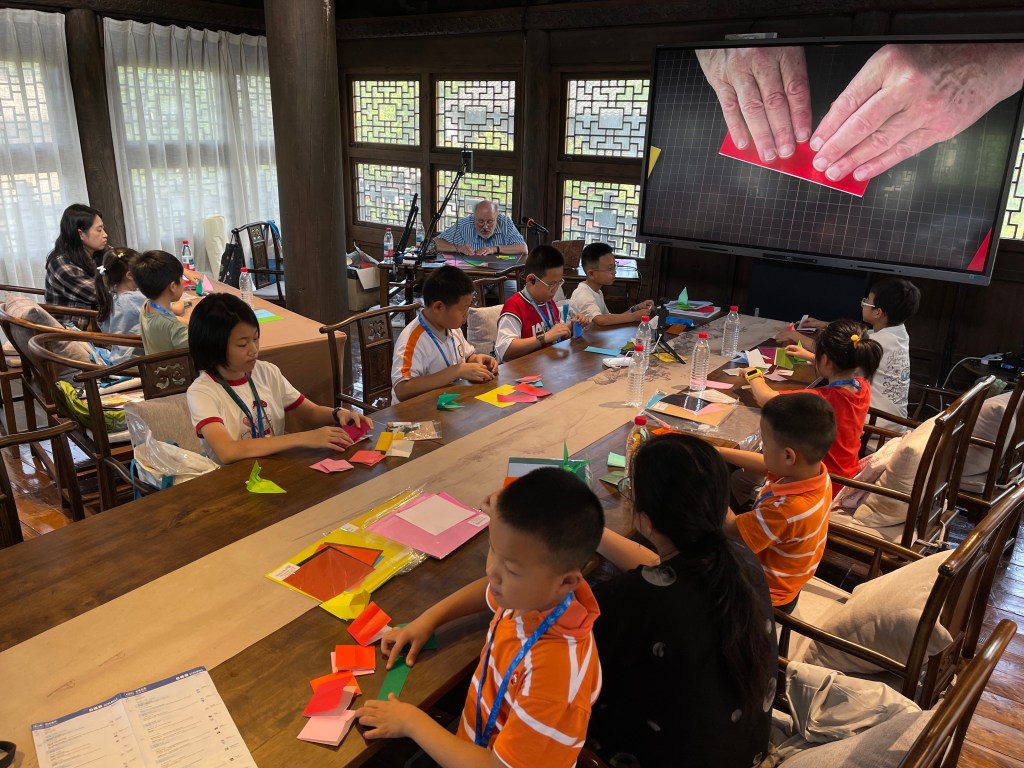
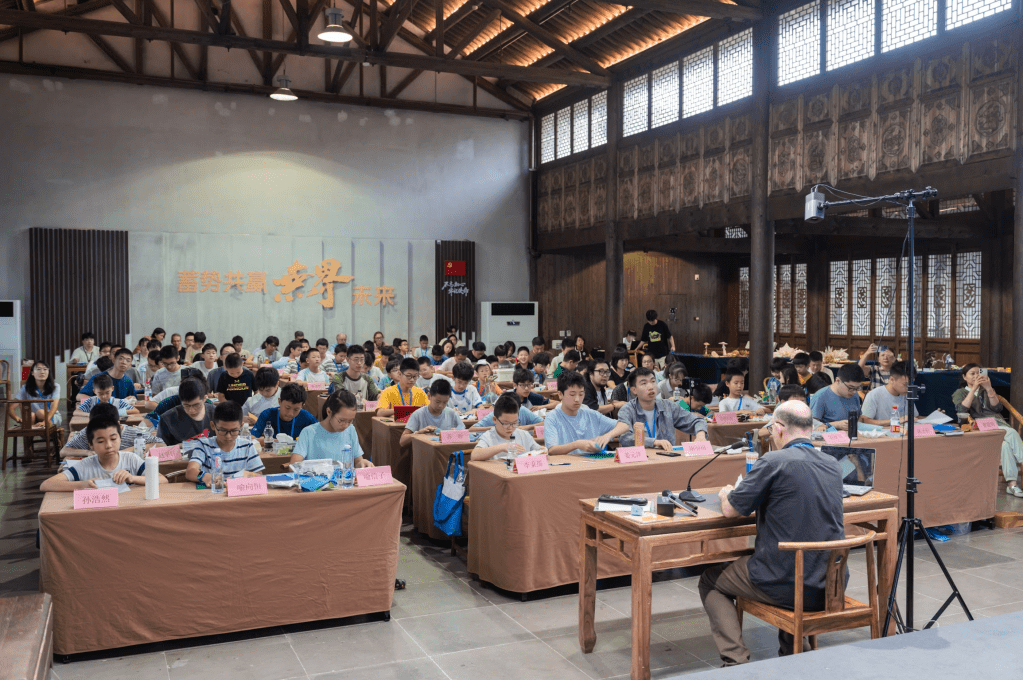
Origami Joy (18-23 July) took place in a first floor room of an old temple style building, where there were about 40 young students of ages 7-14, sometimes accompanied by parents.
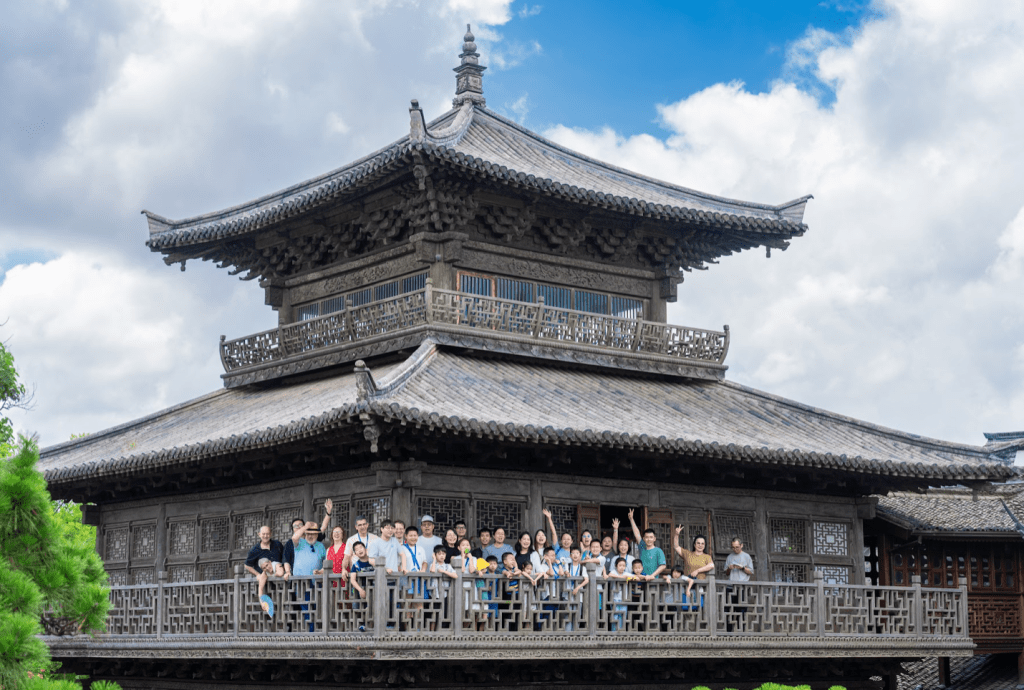
Teachers and students at Origami Joy
Origami Joy was for beginners and younger folders, and we were impressed that their folding abilities which were surprisingly high. An overhead camera above our folding table projected the process onto a screen, visible to all.
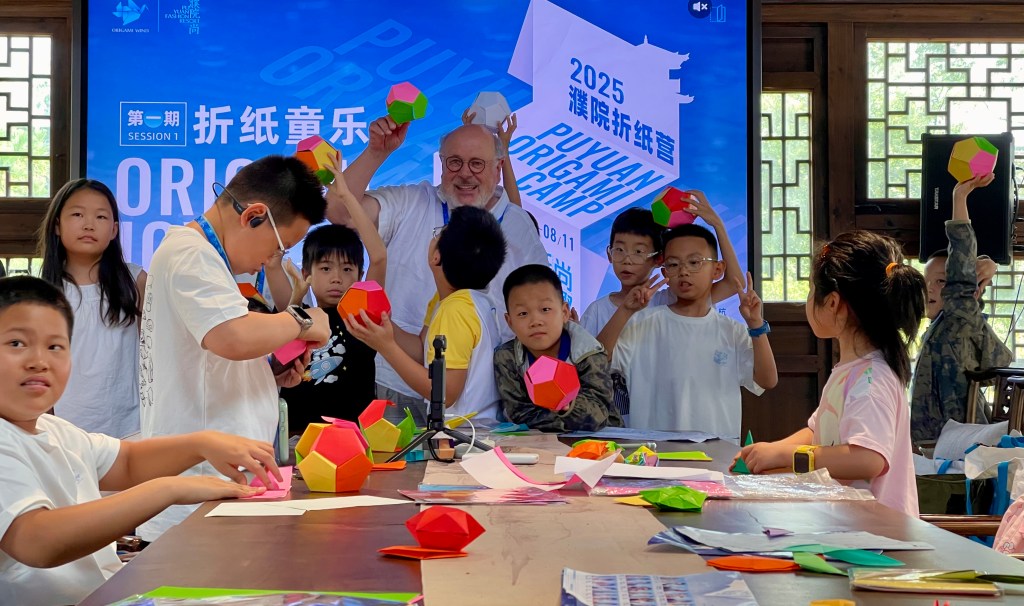

Assia’s bunting class was a particular success and the students quickly decorated the folding room with colourful flags. Sometimes youthful enthusiasm got the better of our students’ patience: we did our best to calm down the occasional excitable ones. At the end all teachers and the students went away satisfied.

We joined in workshops by our fellow guests including Roman Diaz, Cuong, Quyet, Ilan Garibi and Wang Hao, seen here teaching his Chinese costumes.

D’nA with Pan Hang
Origami Convention (25-28 July) was for experienced folders of higher ability, and we moved to an enormous modern auditorium with high ceilings.
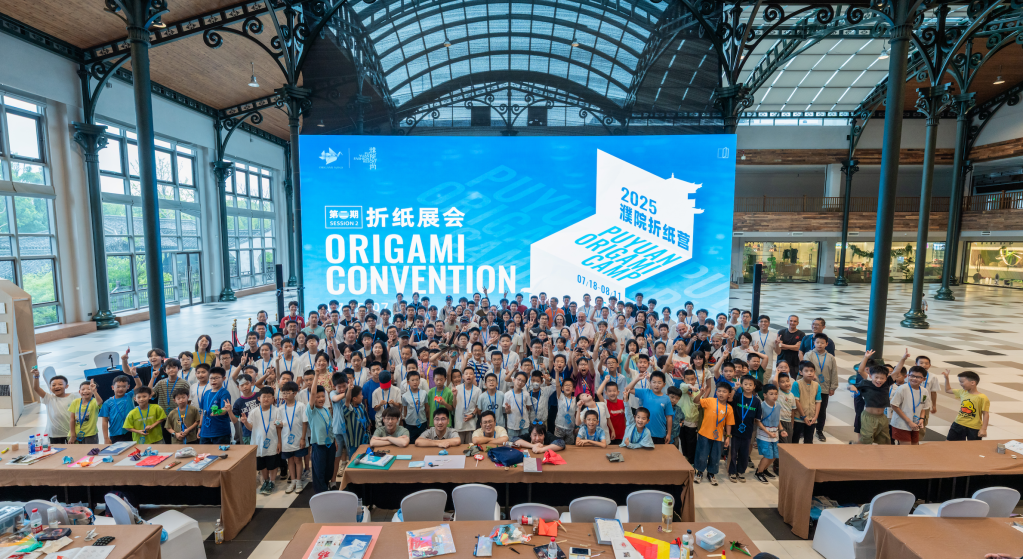
This huge space was carefully laid out with row upon row of chairs and tables. An immense screen, approximately 10 metres high was set up in front of the auditorium.
All guests set up a display table of their own designs, forming a large and varied exhibition for all delegates to view.
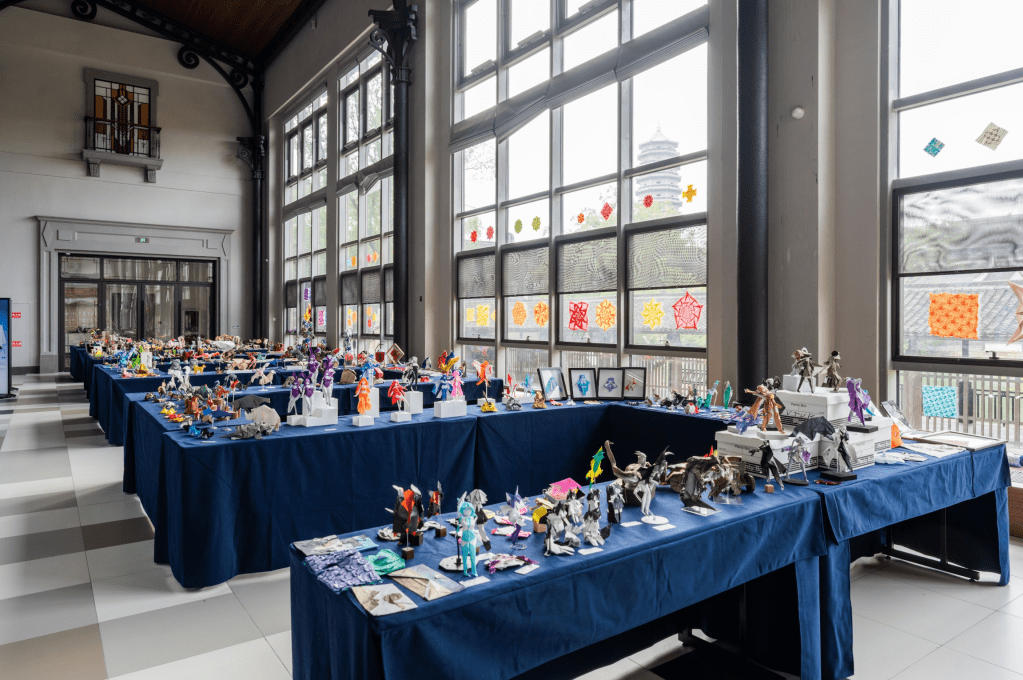
Here are some of our favourites:

Chen Xiao: Bunny Girls
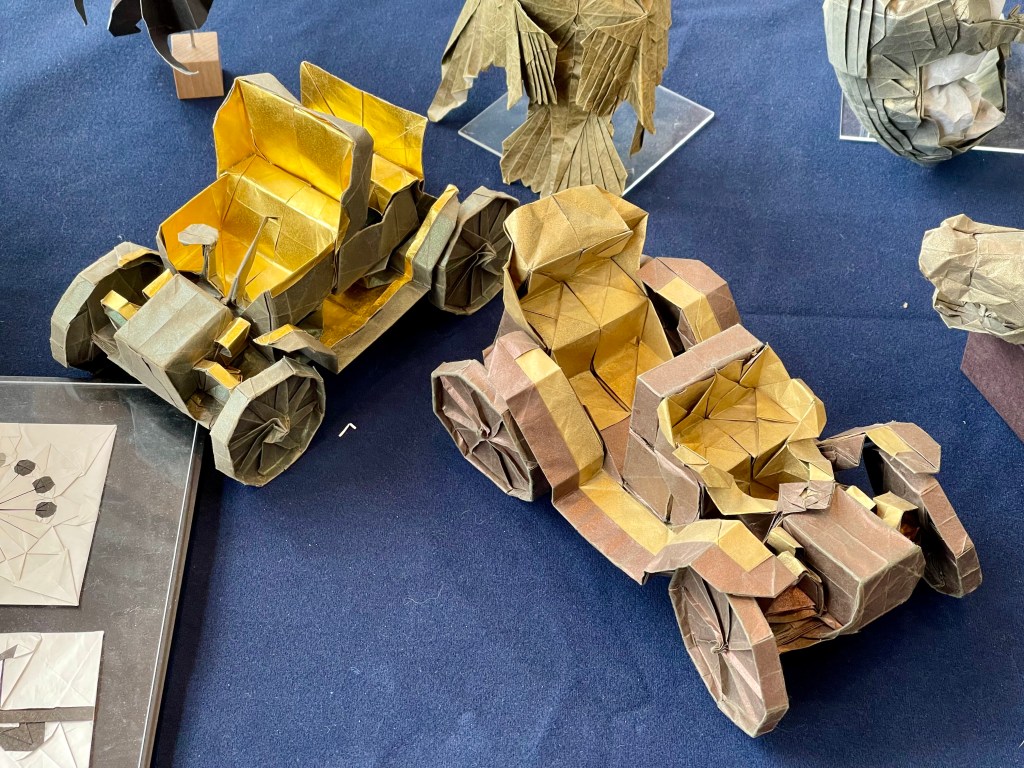
Kei Morisue: Vintage Cars
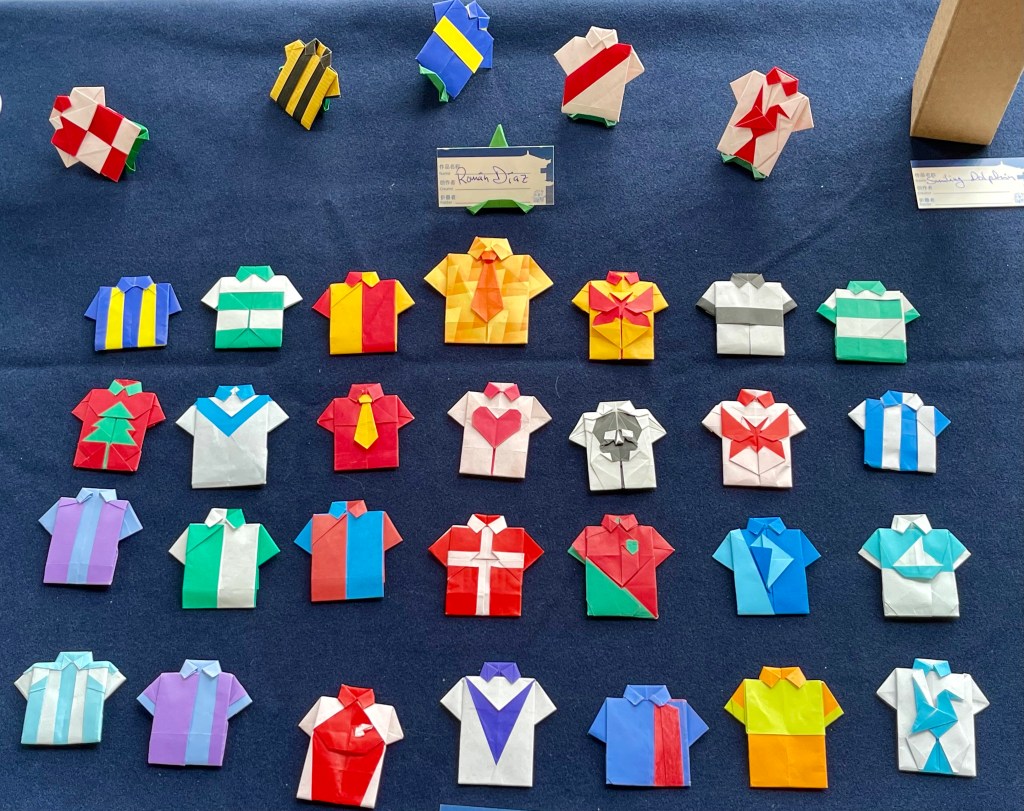
Roman Diaz: Football shirts series
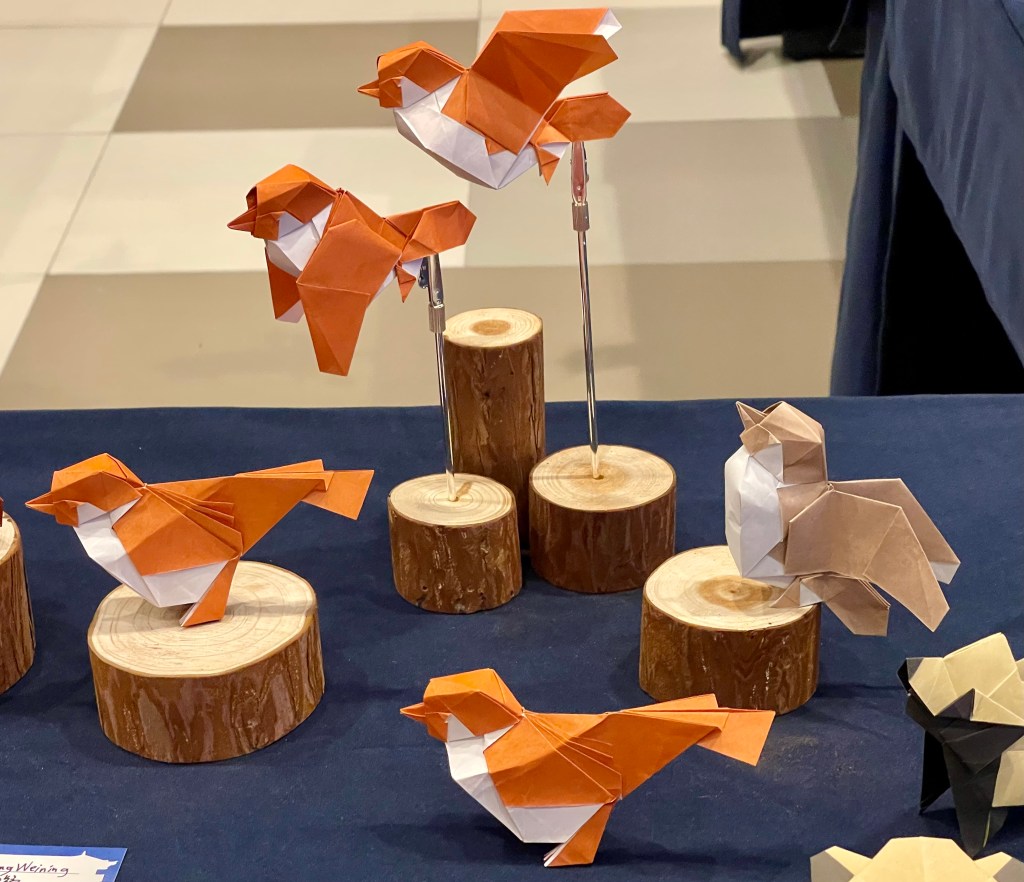
Meng Weining: Sparrows

Bodo Haag: Unicorn
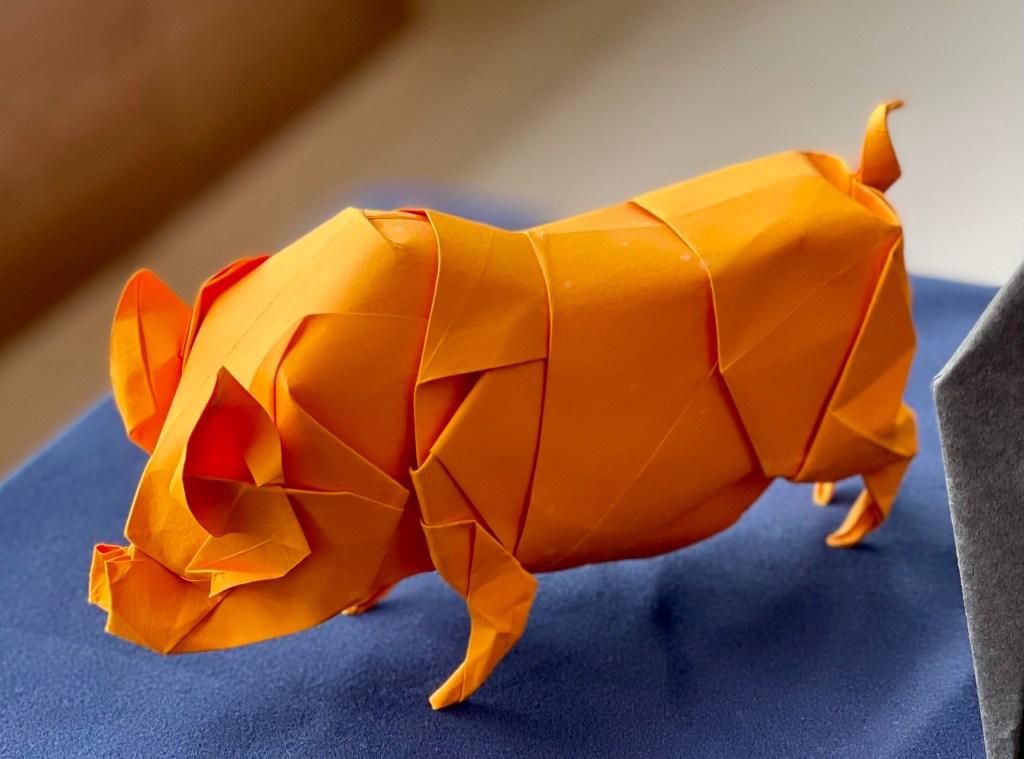
Nguyen Hung Cuong: Pig

Tomoko Fuse: Nesting boxes
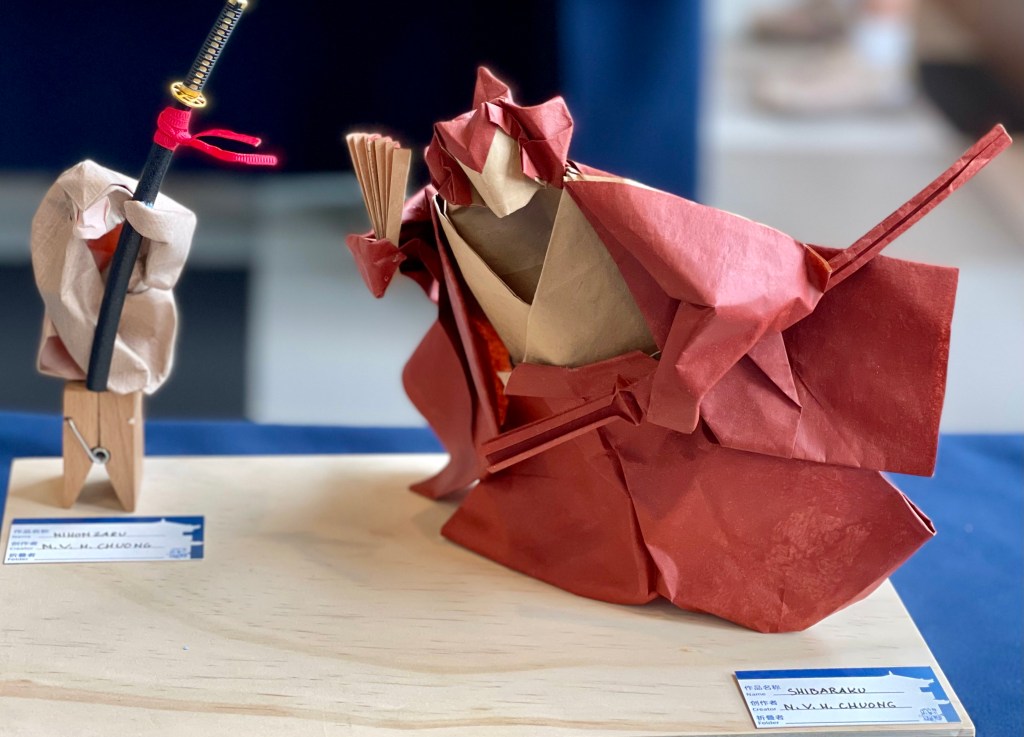
Chuong: Shibaraku (Japanese kabuki character) and Monkey

Bushi: Crocodile

Wang Hao: Chinese costumes
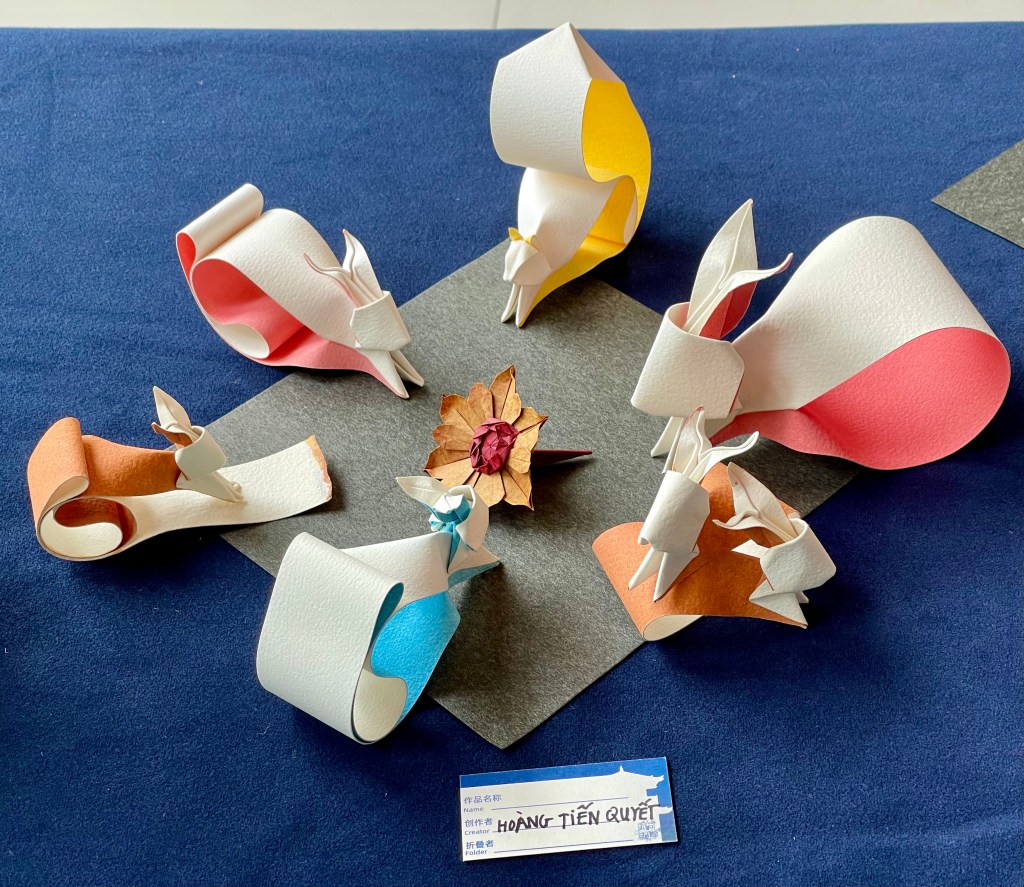

Hoang Tien Quyet: Rabbits and Sculpted heads
As before an overhead camera projected the teachers’ folding space onto the gigantic screen, clearly visible to the delegates who were seated at the tables in the hall.


Each workshop ran consecutively for all delegates in the hall and there were no parallel sessions. Our students ages were higher than for Origami Joy, but there were many young very capable folders too. Everyone could fold more or less continually for four long days, starting at 8.30am and running until 11.30pm.


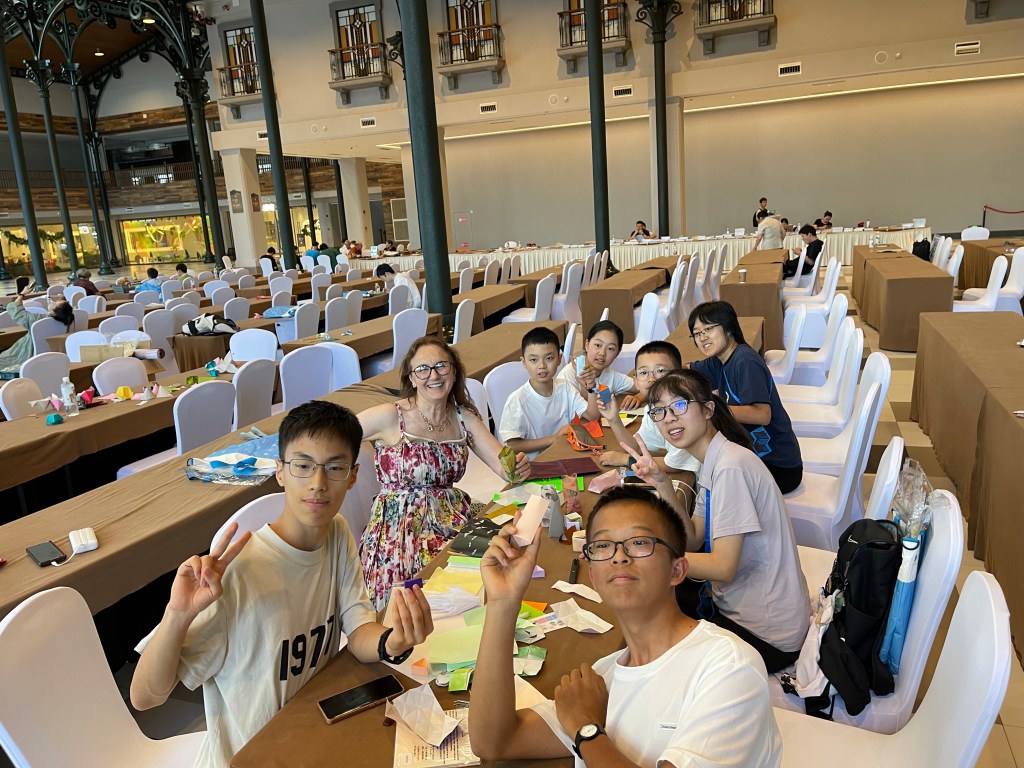
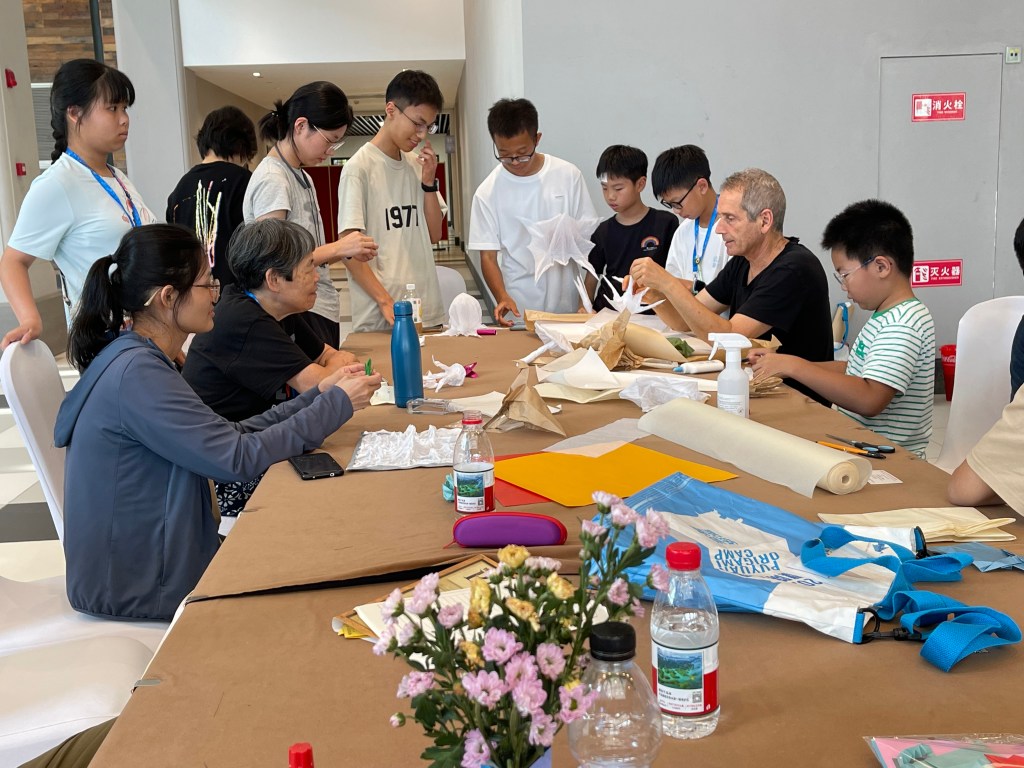
We had time to mingle with the delegates, joining in impromptu workshops. The language barrier was at times difficult, but with the help of mobile phone translation apps, and of course that international language called origami, we were able to communicate.
Origami Master (30 July-4 August)
Roman Diaz is seen here teaching a smiling Dolphin at Origami Masters, now at a third location, a former merchants’ hall. This was for about one hundred delegates and aimed at highly experienced folders prepared to tackle complex designs and many young enthusiasts once again proved their skills during the next few days. Both folding workshops and presentations by guests were given during this part of the event. We reinstalled our exhibits here.

Assia having fun with our Pseudodec unit design

Horse folders

Bodo Haag shows his Low-Poly Sheep

Traditional Bases and the Potential of One Flap, a presentation by Hoang Tien Quyet, shared his methods for developing traditional bases to provide new possibilities and colour changes. Quyet showed his vision and his extremely sensitive feel for the paper, as well as his ability to edit and simplify his chosen subject.
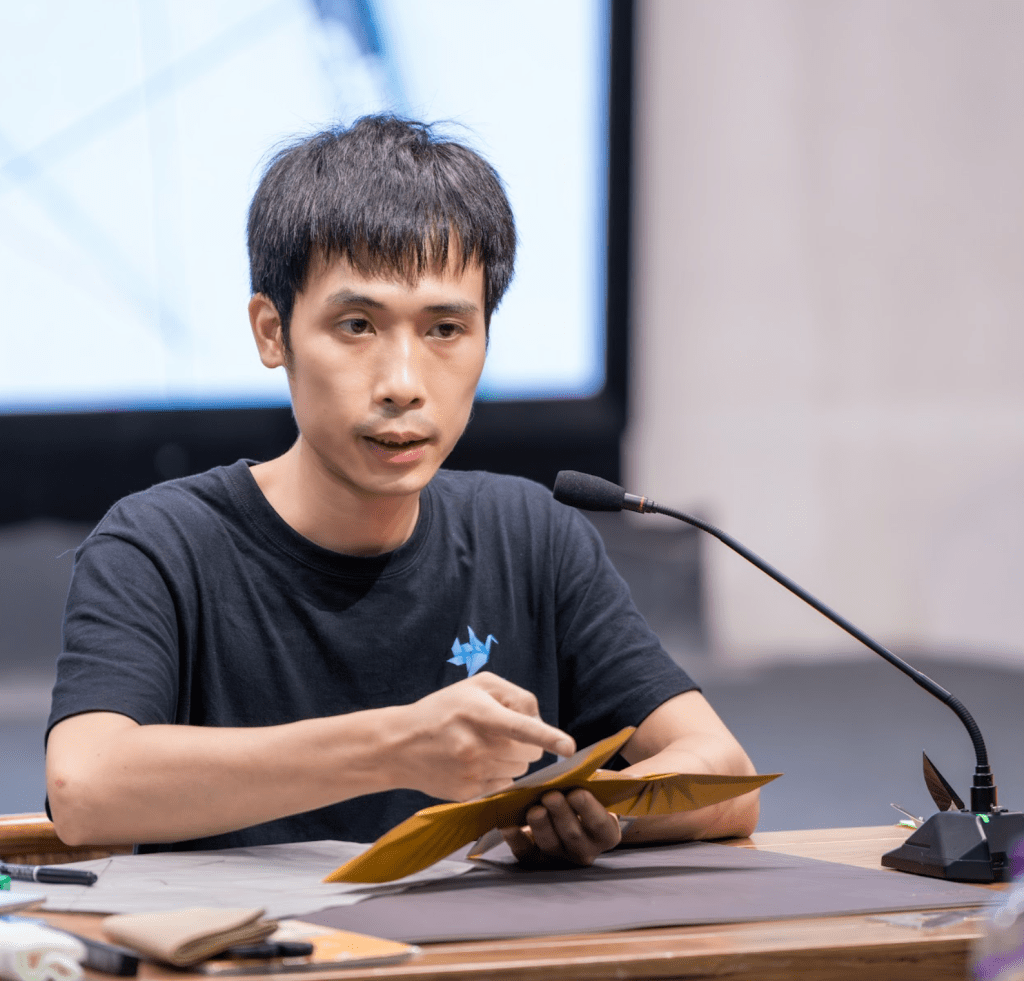
Nguyen Hung Cuong – another top line Vietnamese designer – taught the beautiful swallow; a two piece design with highly organised and complex precreasing.
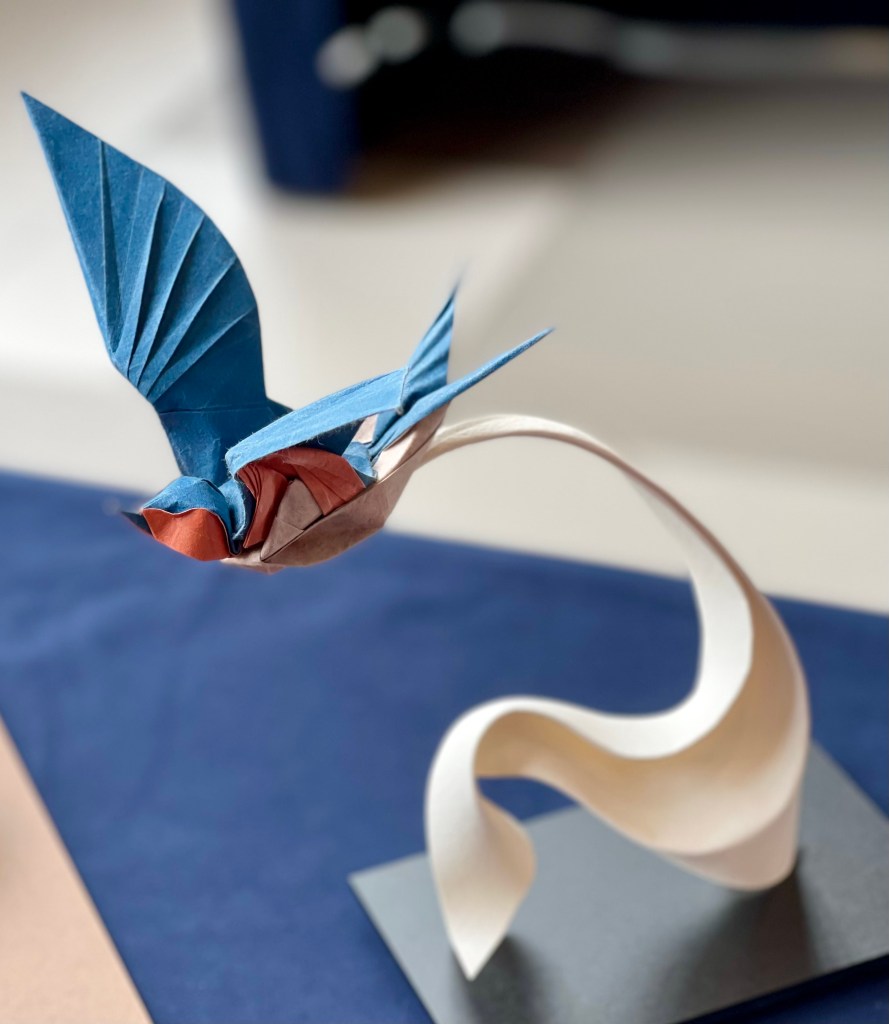
Cuong’s swallow is elegant and graceful, once again displaying a fine touch and a lively result. The two sections of the model (head and wings, and tail and body) were connected by multiple ingenious locks, without glue. A masterpiece.
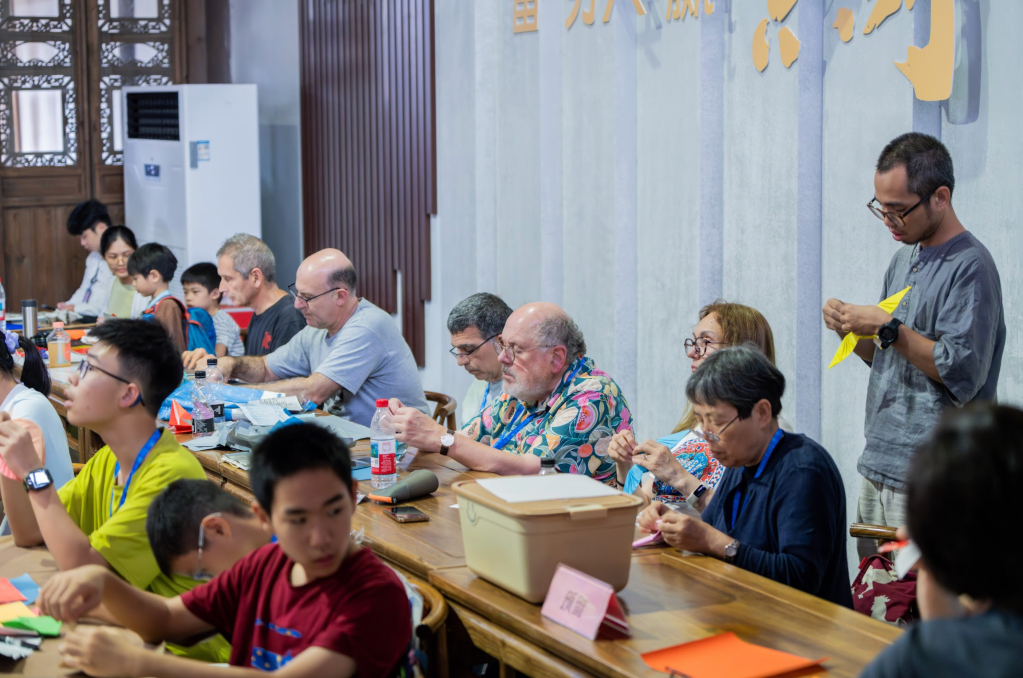
Teachers learning and concentrating: L-R Vincent Floderer, Roman Diaz, Ilan Garibi, DB, AB, Tomoko Fuse, Hien Cheong

Vincent Floderer showed his ever-green crumpling techniques for producing hyper-realistic mushrooms and semi abstract forms: Vincent employed his infectious enthusiasm through the whole event with unscheduled session to anyone interested, and there were many takers!

Tomoko Fuse presented her experiments with tapering strips, and gave a performance of some examples of nesting solids, focusing on cubes and 3D space.

Ilan Garibi challenged us with new tessellation ideas: he’s seen here playing volleyball with one of his unit balls.

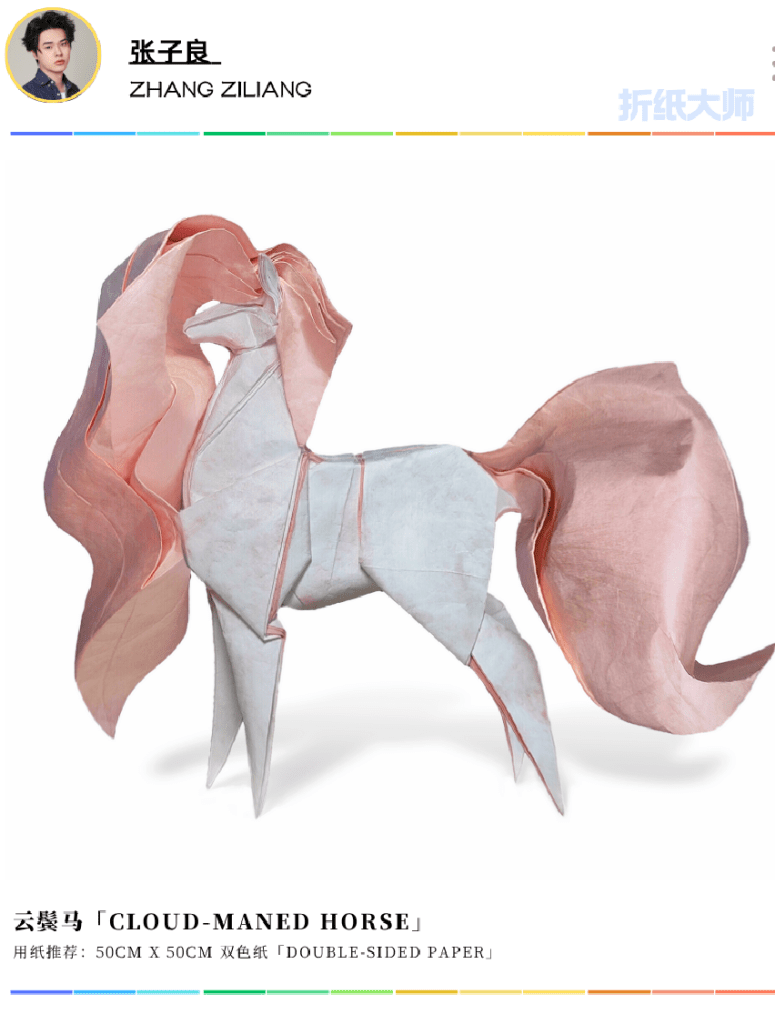
Zhang Ziliang’s horse class with young masters.

Presenting Pang Hang with a souvenir of England.
Assia and I returned home on 4 August, and so we missed the final Origami Beyond event. However, we were tantalised by the work of the latest arrival for this section, Haruki Nakamura.

Haruki Nakamura with his pop-up work
Nakamura’s ingenious paper craft offers surprise transformations of animals springing into shape from a flat package, and geometric solids appearing by magic. We’d have liked the chance to see more, but our flight was waiting.
You’ll realise that Origami Camp was not a holiday or a tourist experience! We worked hard for our sessions. Our reward was a great feeling of warmth and friendship: not only could we catch up with the latest from our old friends, but deeper connections were made with those we didn’t know well or hadn’t met before. It was the perfect example of origami allowing a wider perspective of the experiences of folders from quite different backgrounds from our own.
The intense summer heat, high humidity and our teaching responsibilities meant that unfortunately we didn’t explore further afield. During our 16 days in China, we spent almost all of our time in Puyuan Fashion Resort. We did manage a trip to a nearby shopping mall in TongXiang, while other guests had days in Shanghai and Hangzhou: a few problems with language and making payments didn’t spoil their days.
An unsung hero of our stay was Mr Wu, whose responsibility was to make sure the teachers were in the right place at the right time: this he achieved magnificently, despite our disorganisation and dawdling. In addition he willingly gave tourist advice, ordered and paid for taxis on our behalf, and showed us where to go whenever we lost our way in Puyuan’s labyrinthine streets.

But mastermind Pan Hang almost single-handedly conceived and controlled everything to do with this huge event: from the invitations which we received in the spring of 2025, assistance with our visas, fights, airport transfers, provision of all our meals, and our luxurious accommodation at the resort. We are in awe of his inexhaustible energy, calm organisation, and ambitious vision which was magnificently achieved.
Our immense thanks to Hang and Wu, and indeed all others who contributed to our amazing time in China.
Dave and Assia Brill
August 2025
(Photo credits: Puyuan Fashion Resort, Roman Diaz, Assia and Dave Brill)
 David Brill